Scientists are fond of making futuristic predictions. It helps challenge and broadens their mindsets. But then, should we always trust their predictions?
During World War II’s closing stages, scientists predicted the use of flying cars in the future. Many years have passed, and we aren’t even close to achieving such.
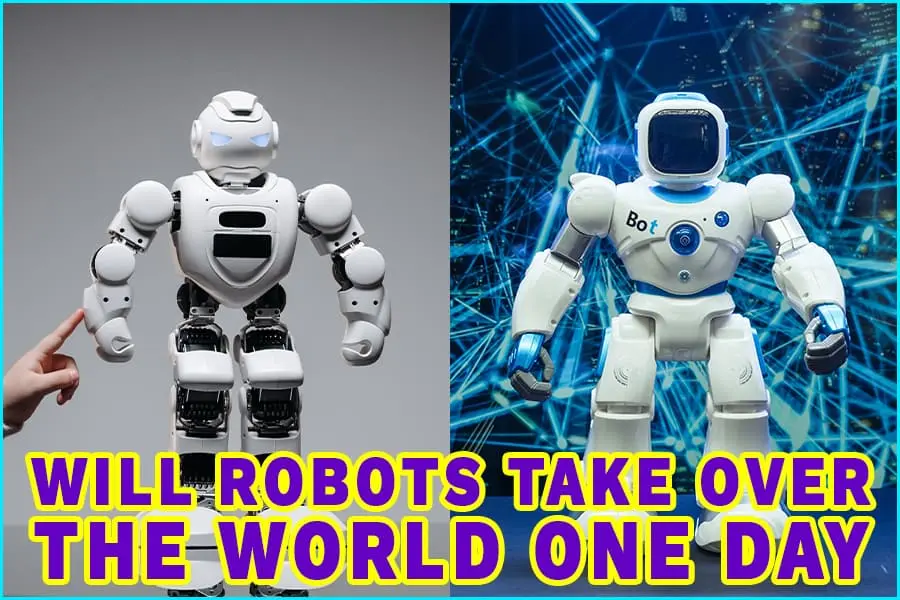
Another prediction pessimists are making is about robots. They believe robots will take over the world one day. Elon Musk has even voiced his thoughts on this subject, taking the side of those who believe humans will play second fiddle to robots someday.
So, here’s the question we will be addressing.
Will robots take over the world one day?
The question shouldn’t be “will” but “can.” Is robot uprising possible? Do robots have what it takes to make it happen?
It can only happen in the movies, but in reality, it can’t. Robots can’t take over the world. It won’t happen now or in the future.

Will Robots Replace Human Labor?
We have already seen this happen. And it will continue as greedy employers seek ways to reduce their workforce and boost profit.
Many companies have already invested massive amounts in research as they seek to build robots capable of replacing workers.
And yes, robots can put in more hours than humans. They can work 24 hours, while humans can’t. Doing so will be disastrous to one’s health.
However, robots can only be productive for jobs they can do. They can’t do most jobs, no matter how high-tech or advanced they become.
So, predicting that millions of jobs would be lost as many jobs would become automated isn’t guesswork. It is already happening.
But here’s the thing. Machines may succeed in automating several tasks and behaviors. Unfortunately, they lack the critical thinking and cognitive skills needed to execute complex and subtle tasks.
So, if you’re worried that robots will take over the world one day, put that fear aside. It would never happen, and below are the reasons why.
Why Robots Can’t Take Over The World In The Future
Now, let’s be honest with ourselves. AI is advancing fast. Robotics engineers are turning up the heat in the industry, creating robots with unimaginable capabilities.
We believe there’s more to come in robotics. We would see robots do things we never thought were possible. But pessimists have to slow down with their claims that robots will take over the world.
Now, what prominent personalities support the prediction that robots will take over the world from humans.
Many have voiced their opinions about a robot takeover in the future. But Elon Musk’s position on the topic is one of the most talked about.
Here’s why we think robots will never take over the world.
#1: Robots’ hands aren’t as flexible as humans’:
Let’s start with the most obvious fact. Can robots’ hands operate like human hands? No! The human hand is complex and super flexible. Thus, producing a replica would be quite challenging.
Robots do possess hands, though, but theirs are quite clumsy. Surprisingly, robotics engineers aren’t blind to this fact. They have attempted but haven’t successfully built a replica of the human hands in their machines. Even the robot hands made in sophisticated labs haven’t been robust enough.
Many may argue that robots don’t need to have hands as complex as humans’ to take over the world. But that would be another flimsy excuse. What impact can they have without such a feat?
The truth is that robots’ hands can’t be like human hands. But let’s face it; the clumsy nature of robots’ hands doesn’t make them less effective. They use their hands like humans, but there’s a limit to what they can do.
#2: Robots’ tactile sensors are no match for the human brain:
Robots will advance and act more intelligently. Robotics engineers are doing their very best to achieve that.
So, expect robots’ tactile sensors to interpret and react to messages in a more sophisticated manner in the future.
Now, here’s one thing that will never happen. Robots’ tactile sensors can never be more sophisticated than the human brain.
The human brain is more complex and unique than tactile sensors designed in a lab. Robotics engineers can try hard and improve their sensors. But they can never replicate a human brain.
Well, we’re not being pessimistic, just stating the obvious. Humans or animal skin, responsible for perception, has no technical match, too.
So, before Elon Musk and friends talk about a possible robot taking over, they should ensure that robots’ tactile perception becomes as sophisticated as humans’.
But then, we know that’s not possible. Thus, a robot uprising isn’t going to happen in this century and the ones after. Robotics still has a long way to go.
#3: How manipulative can robots get?
Alright, let’s be optimistic here. Let’s assume robotics engineers successfully replicate the human hands and skin.
Now, here’s the question. With human-like hands and skin out of the way, how can engineers control robots to manipulate objects as humans do? That’s another big hurdle.
Kids develop the ability to manipulate objects for many years. It doesn’t happen overnight. The mechanism behind it is not something engineers can decipher in a lab. They don’t even understand it.
So, how will robots take over the world when they’re still lacking in this area? Maybe pessimists who believe this is possible have watched too many Hollywood movies about robots.
#4: Robot and human interactions are worlds apart:
Human interaction is complex. Humans build and sustain relationships. But then, can robots do the same? Well, the answer isn’t farfetched.
Human interaction is a complex process. It is built on well-functioning speech, tactile sensing, and object recognition, including senses of smell and taste.
However, there has been significant development in object recognition and speech development in robots. Unfortunately, such robots are only used in controlled environments.
#5: Human reasoning
Who makes the robots? Humans! And don’t forget, not everything that’s technically possible needs building.
What does this imply? Humans can choose not to produce sophisticated robots if they believe doing so would be dangerous to society.
Additionally, even if we decide to make robots that are complex and more similar to humans, chances are the authorities could enact laws that would prohibit their use.
Conclusion
So, will robots take over the world one day? No, they won’t and can’t. Robots might be able to snatch a couple of jobs from people. But they cannot replace human labor completely.
Humans are complex machines. Their parts, behaviors, and sense of reasoning are too complex for robotics engineers to replicate.
Take the human hand, for example. The human hand is complex and super flexible. Robotics engineers haven’t been able to replicate it. They don’t know how to.
By the way, we make robots and can decide how far we want to go in their development. The government policies will also keep the development of high-tech robots in check.